



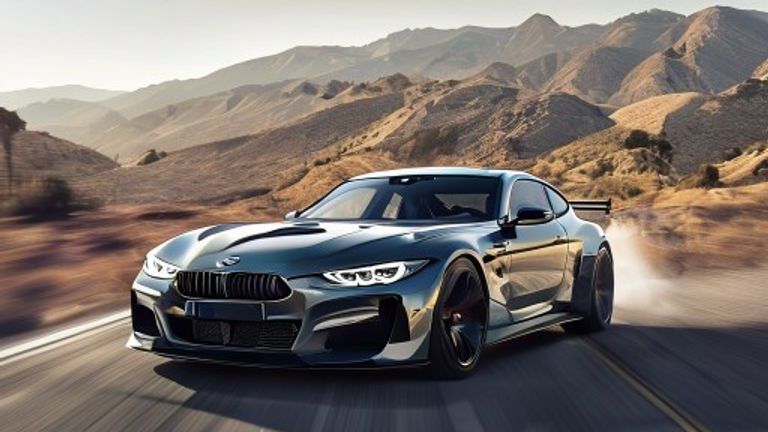
Anticipating the 2026 BMW M2 CS: A Compact Performer on California’s SR-58
The world of high-performance automotive journalism offers tantalizing glimpses into the future. A recent sighting suggests what is anticipated to be the 2026 BMW M2 CS, a vehicle promising to encapsulate BMW M’s intense performance philosophy within a compact footprint. Our brief encounter with this focused machine on the challenging stretches of California State Route 58 serves as an early indicator of the exhilarating driving experience awaiting enthusiasts. The M2 CS, even in its early stages, represents a distillation of speed, agility, and driver engagement, making its appearance on California’s demanding roads noteworthy.
BMW’s M2 series has long been celebrated for its return to a more traditional M car ethos: a potent engine in a relatively small, lightweight chassis. The « CS » (Club Sport) designation elevates this formula further, signifying a model specifically engineered for enhanced performance, often incorporating elements honed on the racetrack. Historically, CS models feature increased power output, significant weight reduction, and highly optimized chassis dynamics compared to their Competition counterparts. For a future 2026 M2 CS, this implies a likely evolution of the acclaimed S58 twin-turbocharged inline-six engine, paired with a chassis that is more aggressive, precise, and connected than ever before. Its core appeal remains its duality: « petite » in dimensions for agility, yet brimming with « a lot of performance » for breathtaking thrills.
The development of a CS model involves a meticulous approach to engineering. Beyond raw power, expected enhancements typically include a suite of weight-saving measures. This often involves extensive use of carbon fiber reinforced plastic (CFRP) for components such as the roof, hood, front splitter, rear diffuser, and even interior trim. Such material choices not only reduce mass but also lower the car’s center of gravity, contributing to improved handling characteristics. Furthermore, CS models usually receive bespoke suspension tuning, potentially featuring unique spring and damper rates, along with recalibrated steering for heightened responsiveness and feedback. Braking systems are invariably upgraded to cope with increased performance, often incorporating larger discs or even ceramic-composite rotors for fade-free stopping power during spirited driving.
The choice of California State Route 58 as a testing ground for such a vehicle is astute. SR-58 is renowned among driving enthusiasts for its diverse and demanding character. Beginning in the Central Valley, it quickly ascends into the foothills and across the Temblor Range, featuring a captivating mix of sweeping, high-speed corners, technical tighter sections, and significant elevation changes. This variety makes it an ideal environment to assess a performance car’s comprehensive capabilities – from its engine’s tractability and power delivery to its chassis’s ability to maintain composure through challenging transitions. The stark, often remote landscape provides an uninterrupted backdrop for focused driving, allowing for a pure connection with the machine.
For a car like the M2 CS, the attributes of SR-58 would be particularly revealing. The compact size of the M2 allows it to navigate the narrower, more intricate sections of the route with precision and agility that larger performance cars might struggle to match. Its expected potent powertrain would enable rapid acceleration between corners, making quick work of the straights and uphill sections. Meanwhile, the specialized chassis and braking systems would be pushed to their limits through the route’s challenging downhill descents and demanding apexes, providing crucial feedback for engineers. The blend of a driver-focused car and an engaging road creates a symbiotic relationship, where each highlights the best of the other, underscoring the potential of the 2026 M2 CS as a true driver’s car.
The legacy of the M2, from its initial launch to the acclaimed M2 Competition and prior M2 CS models, has firmly established it as the purist’s choice within the modern BMW M lineup. It consistently delivers an unfiltered driving experience, often cited as the closest modern equivalent to earlier, revered M cars. The « CS » badge itself carries significant weight, having graced other iconic BMW M models like the M3 CS and M4 CS, each representing a more extreme, track-capable iteration of their respective series. This heritage sets high expectations for the 2026 M2 CS, promising a vehicle that will not only meet but likely exceed the already lofty benchmarks set by its predecessors, refining the concept of a lightweight, powerful, and exceptionally agile performance coupe.
As development continues towards its anticipated 2026 debut, the potential of the BMW M2 CS, even on California State Route 58, remains immense. It speaks to BMW M’s continuous pursuit of the ultimate driving machine, prioritizing driver involvement and dynamic purity. Enthusiasts can look forward to a car that is not merely fast but profoundly engaging, a true enthusiast’s delight designed to conquer challenging roads and deliver an unforgettable experience. The M2 CS represents a commitment to performance driving’s core values, distilled into an accessible yet intensely rewarding form.
- Targeted Agility: Compact form factor enhancing responsiveness.
- Potent S58 Engine: Expected significant power output from BMW’s acclaimed twin-turbo inline-six.
- Weight Reduction Focus: Extensive use of carbon fiber for body and structural components.
- Dedicated Chassis Tuning: Specific suspension, steering, and braking calibrations for heightened precision.
- Aerodynamic Optimizations: Functional design elements for improved downforce and stability.
- Purist’s Interior: Performance-oriented cockpit with focus on driver engagement.
- Illustrious CS Heritage: Continuation of BMW M’s « Club Sport » legacy for ultimate performance.
Source : https://www.caranddriver.com/reviews/a71178934/2026-bmw-m2-cs-test/