


The Unforeseen Reality: When Muscle Meets Mass
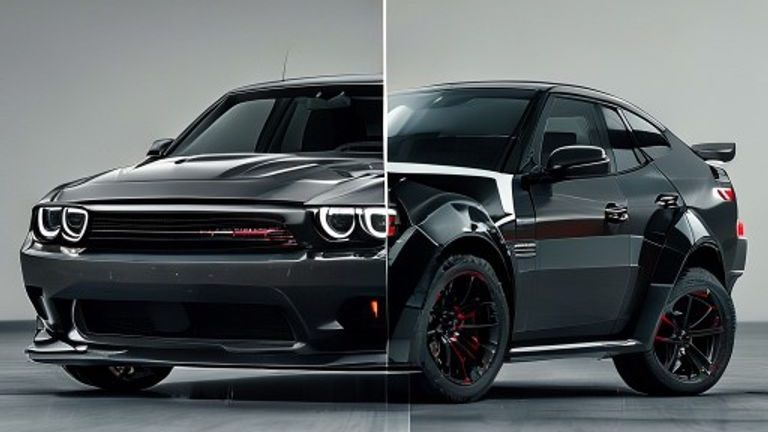
In the dynamic world of automotive engineering and design, certain assumptions are often held as conventional wisdom. One such assumption might be that a large, three-row, eight-passenger SUV would, by virtue of its size and capacity, outweigh a performance-oriented muscle car. However, recent observations challenge this notion directly: the Dodge Charger R/T has been noted to be heavier than the Mazda CX-90, a significant three-row SUV. This isn’t merely a curious anomaly; it opens a fascinating discussion about design philosophies, material science, and the evolving priorities across different vehicle segments.
The core observation is stark: a vehicle celebrated for its raw power and American muscle aesthetic carries more mass than a modern SUV engineered to transport multiple passengers comfortably and efficiently. This isn’t about labeling any vehicle as ‘overweight’ but rather about dissecting the implications of such a weight disparity and understanding the underlying engineering decisions that lead to such outcomes.
Understanding Curb Weight: More Than Just Size
Curb weight refers to the total weight of a vehicle with all its standard equipment, necessary fluids (like engine oil and coolant), and a full tank of fuel, but without any passengers or cargo. It’s a critical metric that impacts virtually every aspect of a vehicle’s performance, from acceleration and braking to fuel efficiency and handling dynamics. When a muscle car like the Charger R/T tips the scales heavier than an SUV designed for family hauling, it prompts an examination of the various factors contributing to this mass.
- Platform Longevity: The Charger’s platform has a longer lineage, often implying designs rooted in eras where weight optimization wasn’t always the primary driver compared to sheer structural robustness and power accommodation.
- Modern Engineering: Newer platforms, like that of the Mazda CX-90, frequently leverage contemporary advancements in materials and structural design, such as high-strength steels, aluminum alloys, and sophisticated bonding techniques, to achieve greater rigidity with less mass.
- Design Intent: While muscle cars prioritize durability and the ability to handle powerful engines, modern SUVs balance these needs with a strong emphasis on efficiency, safety, and a refined driving experience, which often benefits from a lighter, stiffer chassis.
Impact on Performance and Driving Dynamics
For a performance car, additional weight can be a double-edged sword. While some mass can contribute to a solid, planted feel on the road, excessive weight inherently detracts from agility and outright speed. The Charger R/T, despite its powerful engine, would naturally experience a greater demand on its powertrain to achieve comparable acceleration figures if it carries more mass. This also extends to other critical dynamic aspects:
- Acceleration: More mass requires more energy to move, potentially diminishing the ‘punch’ expected from a muscle car and requiring more power from the engine to achieve desired speeds.
- Braking: Heavier vehicles build up more kinetic energy, demanding larger and more robust braking systems and consequently longer stopping distances, a crucial safety consideration.
- Handling: Increased weight can translate to greater inertia, potentially leading to more body roll in corners, reduced responsiveness, and a less nimble feel, which is particularly noticeable in a vehicle segment where dynamic performance is paramount.
Conversely, for an SUV like the CX-90, achieving a lighter curb weight while maintaining its structural integrity and accommodating up to eight passengers is a significant engineering feat. It means better fuel economy, potentially more agile handling for its size, and a more car-like driving experience, which is increasingly desired by consumers in the SUV market.
Fuel Efficiency Implications and Running Costs
One of the most direct and widely understood implications of vehicle weight is its impact on fuel consumption. A fundamental principle of physics dictates that more mass requires more energy to accelerate and maintain speed, directly translating to higher fuel usage. For the Dodge Charger R/T, being heavier than a large SUV suggests a potentially higher fuel burn rate, which affects the owner’s running costs and the vehicle’s environmental footprint. In an era where fuel economy standards are increasingly stringent and consumers are more conscious of their impact, this weight characteristic becomes a significant factor.
The Evolution of Automotive Design Philosophies
This weight disparity underscores the divergent evolutionary paths of different vehicle types. Muscle cars, while constantly evolving, often retain certain core characteristics that contribute to their robust construction. This may include heavy-duty components designed for extreme power output and a focus on traditional, solid construction methods. The emphasis is on a visceral, powerful driving experience.
Modern SUVs, on the other hand, have transformed dramatically. They are no longer simply rugged, truck-based utility vehicles. Contemporary designs, like the Mazda CX-90, are engineered for a sophisticated balance of space, comfort, safety, and efficiency. This requires innovative approaches to chassis design, intelligent use of lightweight materials, and advanced manufacturing processes to reduce mass without compromising structural integrity or passenger protection. The objective is to provide a versatile family vehicle that drives with the refinement of a passenger car.
Conclusion: An Engineering Narrative
The observation that the Dodge Charger R/T is heavier than the three-row Mazda CX-90 serves as a compelling narrative about the state of automotive engineering today. It’s not a judgment on either vehicle but rather an insightful data point that highlights the unique challenges and priorities within different automotive segments. It demonstrates how traditional vehicle archetypes are being redefined by advancements in materials science, manufacturing techniques, and a shifting focus towards efficiency and versatility. This unexpected weight comparison prompts enthusiasts and consumers alike to look beyond superficial classifications and appreciate the complex engineering beneath the surface of every vehicle on the road.
Source : https://www.caranddriver.com/news/a72756338/dodge-charger-rt-heavier-than-mazda-cx-90-tested/