
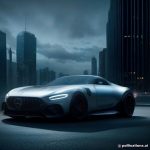
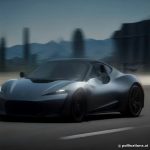
Unveiling the Future: Tesla Roadster and the Promise of Aerospace Technology
Since its re-introduction, the second-generation Tesla Roadster has stood as a towering symbol of electric vehicle ambition and a bold statement about the future of automotive performance. More than just a successor to Tesla’s original groundbreaking electric sports car, the new Roadster was presented not merely as an evolution, but as a revolution. Tesla, known for pushing boundaries in battery technology, software, and autonomous driving, aimed to redefine what an electric sports car could be, setting unprecedented benchmarks for speed, range, and sheer driving exhilaration. The initial reveal generated immense excitement, positioning the Roadster as the ultimate halo car for the brand, a demonstration of what is possible when conventional limitations are discarded.
The vision for the Roadster was clear: to deliver performance figures previously unimaginable in a production vehicle, electric or otherwise. Its planned specifications captivated the automotive world, promising a vehicle that would push the limits of known physics for street-legal cars:
- A claimed 0-60 mph acceleration in a blistering 1.9 seconds, setting a new benchmark for hypercar performance.
- A top speed exceeding 250 mph, pushing the boundaries of what a street-legal car can achieve.
- An estimated range of 620 miles on a single charge, redefining expectations for electric vehicle endurance.
- Practical seating for four, combining extreme performance with surprising usability for a sports car.
These figures, if achieved, would not only establish the Roadster as one of the fastest production cars ever made but also as a leader in long-distance electric travel, challenging preconceptions about EV capabilities. This audacious set of goals underscores Tesla’s commitment to not just compete with, but fundamentally surpass traditional internal combustion engine supercars, making a compelling case for electric propulsion at the pinnacle of automotive engineering.
The Groundbreaking Integration of SpaceX Technology
At the heart of the Roadster’s most ambitious claims lies the much-discussed ‘SpaceX Package.’ This extraordinary addition, first publicly detailed by Tesla CEO Elon Musk, proposed an unprecedented integration of aerospace engineering into an automotive platform. The core concept involved equipping the Roadster with cold gas thrusters, leveraging the expertise gained from Musk’s other venture, SpaceX. These thrusters, distinct from rocket engines, would utilize compressed air to provide bursts of directional thrust, intended to dramatically augment the vehicle’s performance envelope. The very idea of such technology in a road-legal car immediately sparked widespread discussion and speculation about its potential.
Musk’s vision for the SpaceX Package extended beyond mere straight-line speed. While the thrusters were primarily discussed as a means to achieve even more astonishing acceleration figures, potentially pushing the 0-60 mph time below the initially stated 1.9 seconds, their application was also envisioned for enhancing other dynamic aspects of driving. Imagine a vehicle that could use short, powerful bursts of thrust to improve braking efficiency, allowing for shorter stopping distances, or to enhance cornering grip and agility, effectively making the car ‘turn on a dime’ in ways traditional aerodynamics and tire grip alone cannot achieve. The concept suggests a vehicle capable of manipulating its immediate environment with precision, offering an unparalleled level of control and responsiveness to the driver.
The more audacious interpretations of this technology, inspired by Musk’s own statements, hinted at capabilities that verged on the fantastical, such as the ability for the car to perform rapid, dynamic maneuvers, or even to momentarily ‘hover’ or perform short, controlled ‘hops.’ These discussions provided the imaginative fuel for the idea of a car that could seemingly ‘fly’ or ‘flip’ – not in the sense of sustained aerial travel, but in performing incredibly swift and precise directional changes or brief suspensions off the ground. Such capabilities, even if only fleeting, would represent a paradigm shift in automotive physics and driver experience, elevating the Roadster to a category of its own, far beyond typical supercar performance and perfectly aligning with its promised showy debut.
Engineering Challenges and the ‘Behind-the-Scenes Magic’
Bringing such a radical concept from drawing board to production involves immense engineering hurdles and considerable ‘behind-the-scenes magic.’ The integration of high-pressure air tanks, sophisticated valving systems, and advanced control electronics into an already complex electric sports car chassis presents a myriad of challenges. Engineers would need to meticulously design for safety, reliability, and seamless operation, ensuring that the thruster system not only performs as intended but also integrates harmoniously with the vehicle’s electric powertrain, braking, and suspension systems. This fusion of automotive and aerospace disciplines requires an innovative approach to materials science, fluid dynamics, and software control, pushing the boundaries of what is currently understood about vehicle dynamics.
Furthermore, the ‘showy debut’ of such an ambitious vehicle would undoubtedly involve demonstrating these groundbreaking features in a compelling and memorable way. The theatrical element of presenting a car with such capabilities is crucial for capturing public imagination and reinforcing Tesla’s image as a leader in innovation. The ‘magic’ refers not only to the advanced technology itself but also to the rigorous development process – the countless hours of design, simulation, prototyping, and testing required to translate visionary ideas into a tangible, functional product. It speaks to the ingenuity of the teams working to solve unprecedented engineering problems, ensuring that the Roadster, with its SpaceX tech, lives up to its extraordinary promise and delivers an experience truly unlike any other.
The Roadster’s Impact and the Future of Performance
The Tesla Roadster, with its audacious performance targets and the pioneering SpaceX Package, represents more than just a new vehicle; it symbolizes a future where automotive design and engineering draw inspiration from previously disparate fields. It challenges competitors to think beyond conventional powertrains and chassis designs, potentially paving the way for new forms of vehicle dynamics and control systems across the industry. As Tesla continues its mission to accelerate the world’s transition to sustainable energy, the Roadster stands as a testament to the company’s willingness to take bold risks and invest in truly transformative technologies that reshape our understanding of performance.
Its eventual arrival, whenever that may be, is anticipated to be a pivotal moment, not just for Tesla enthusiasts, but for the entire automotive world. It is a vehicle that embodies the spirit of innovation, a tangible representation of how cutting-edge technology, when applied with vision and ambition, can redefine expectations and push the limits of what a car can do. The Tesla Roadster, equipped with its SpaceX technology, remains a beacon of the ambitious future of electric performance, promising a driving experience unlike anything seen before and leaving an indelible mark on automotive history.
Source : https://www.caranddriver.com/news/a74165059/tesla-roadster-thrusters-fan-system-explained/
